
AI adoption is accelerating across enterprises, but so are the operational challenges. Teams are experimenting with OpenAI, Anthropic Claude, self-hosted models, and specialized AI services often all at once. The result can quickly become a patchwork of API keys, duplicated integrations, inconsistent governance, and unpredictable costs.
What starts as a single API key in a development environment often grows into dozens of applications connecting to different providers. API keys become scattered across YAML files, environment variables, CI/CD pipelines, and vaults. At the same time, organizations struggle to answer simple questions: Who is using which model? How many tokens are we consuming? Which application is driving the cost?
As AI agents become more common, this challenge only grows. Agents can now interact with business applications and external tools through standards like Model Context Protocol (MCP), making centralized governance more important than ever.
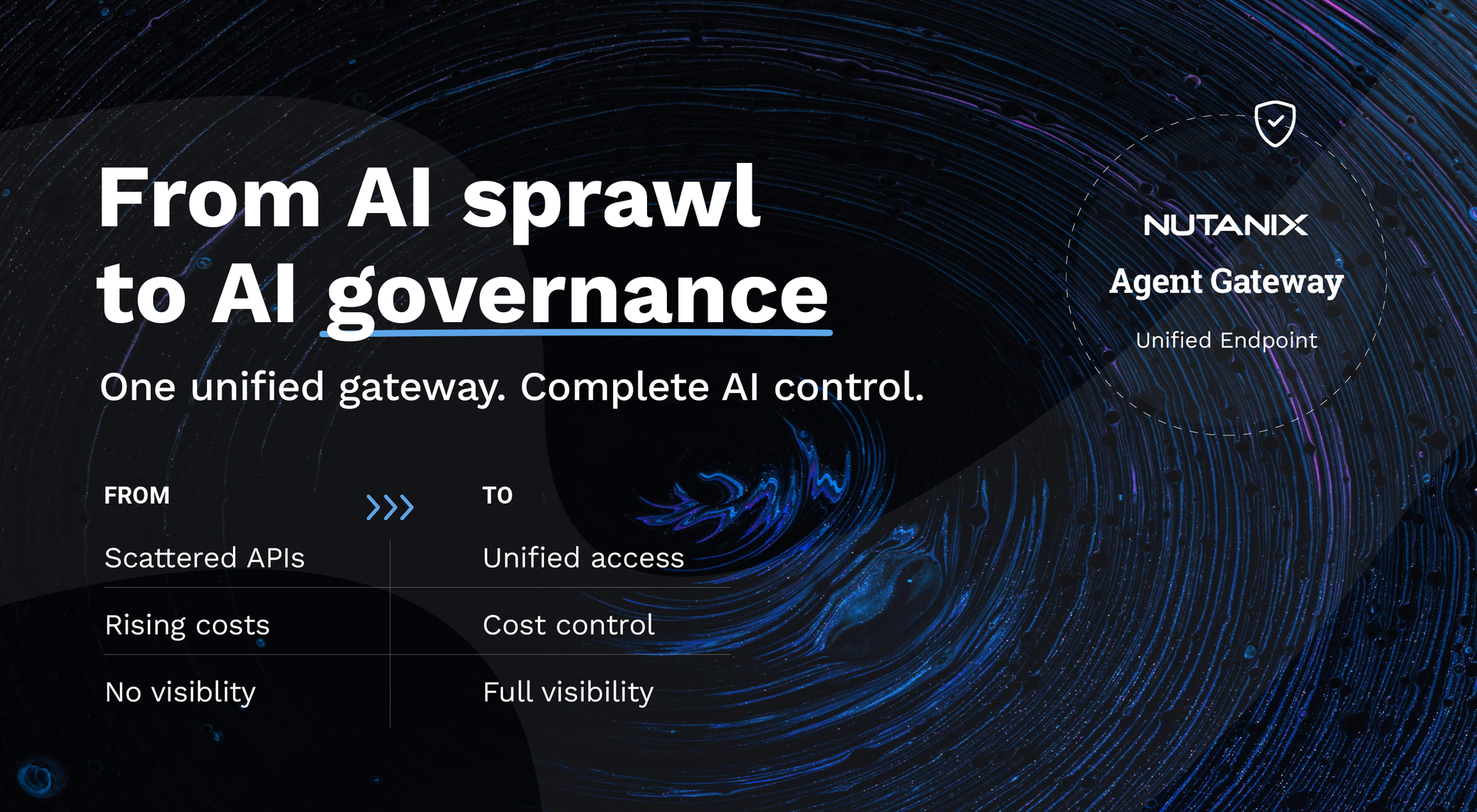
A unified approach to enterprise AI with Nutanix Agent Gateway
With Nutanix Enterprise AI 2.7, Nutanix introduces Agent Gateway, a centralized control layer that sits between AI applications, agents, MCP servers, and AI providers.
Instead of connecting directly to individual providers, applications connect to a single Unified Endpoint using a standard OpenAI-compatible API. Behind the scenes, requests can be routed to public providers such as OpenAI, Anthropic Claude, AWS Bedrock, or even self-hosted models running on your own infrastructure.
The biggest advantage? Your application code remains unchanged. Whether you're using OpenAI today or a self-hosted model tomorrow, the integration stays exactly the same.
Key benefits
Centralized credential management
One of the most common challenges in enterprise AI is credential sprawl. Provider API keys are often distributed across teams and applications, creating security and governance concerns.
Agent Gateway addresses this by storing provider credentials centrally within Nutanix Enterprise AI. Applications never need access to the actual OpenAI or Anthropic API keys. Instead, developers use Nutanix Enterprise AI scoped API keys with RBAC controls, significantly reducing the risk of credential leakage.
API keys leaked = data leaked = no more control over your cost spent => CFO, CTO, CIO and DPO’s nightmare.
Flexibility Without Rewriting Applications
Business requirements change. Costs change. Compliance requirements change.
With Agent Gateway, organizations can switch routing from one provider to another simply by updating the gateway configuration. Moving from OpenAI to Claude, introducing AWS Bedrock, or redirecting workloads to a local model no longer requires a code audit or application redesign.
Cost Control and Resiliency
As AI usage grows, so does the need for governance.
Agent Gateway provides centralized token-based rate limiting, allowing organizations to enforce consumption limits at multiple levels:
- Global token limits across a Unified Endpoint
- Granular limits per endpoint
- Limits per application, team, or API key
In addition, built-in load balancing, rate limiting, and automatic fallback capabilities help maintain service availability. If a provider becomes unavailable, requests can automatically be redirected to an alternative model, helping ensure uninterrupted AI services.
Complete Visibility into AI Usage
Without observability, managing AI costs and adoption becomes nearly impossible.
Agent Gateway logs every request, providing insights into token consumption, model usage, applications, and teams. This allows organizations to better understand where AI is delivering value while maintaining control over spending.
What's new in Enterprise AI 2.7
Beyond Agent Gateway, Enterprise AI 2.7 introduces several new capabilities, including:
- Support for Local MCP Servers (Tech Preview)
- Integration with Palo Alto Prisma AIRS for AI security
- Model scanning and endpoint red teaming
- Batch inferencing capabilities
Final thoughts
The future of Enterprise AI isn't about committing to a single model provider. It's about creating a secure and flexible platform that allows organizations to use the right model for the right use case while maintaining control over security, governance, costs, and compliance.
Nutanix Agent Gateway delivers that control layer, enabling enterprises to abstract AI providers, secure credentials, govern token consumption, and support both public and private AI models through a single unified endpoint.
If you’d like to learn more, feel free to contact me.